SkyLep eclipse calendar
Solar and lunar eclipses
Explore upcoming and past eclipses in one place. Open an event to see its visibility map, local circumstances and observing information.
Upcoming event
Upcoming eclipses
Events that are still ahead, ordered from the nearest date.
 Solar eclipseUpcoming event
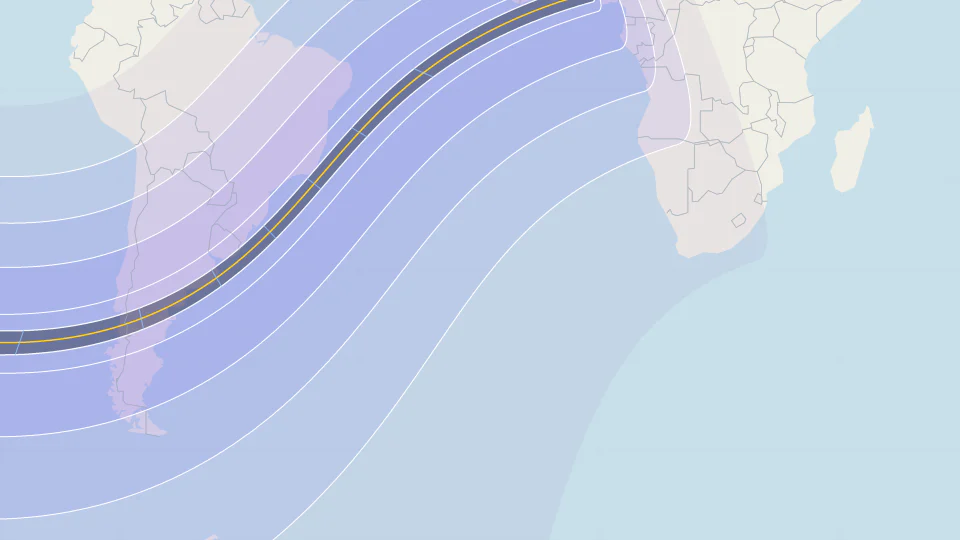
Annular solar eclipse
Visibility: Southern South America, the South Atlantic, western Africa and AntarcticaOpen the eclipse map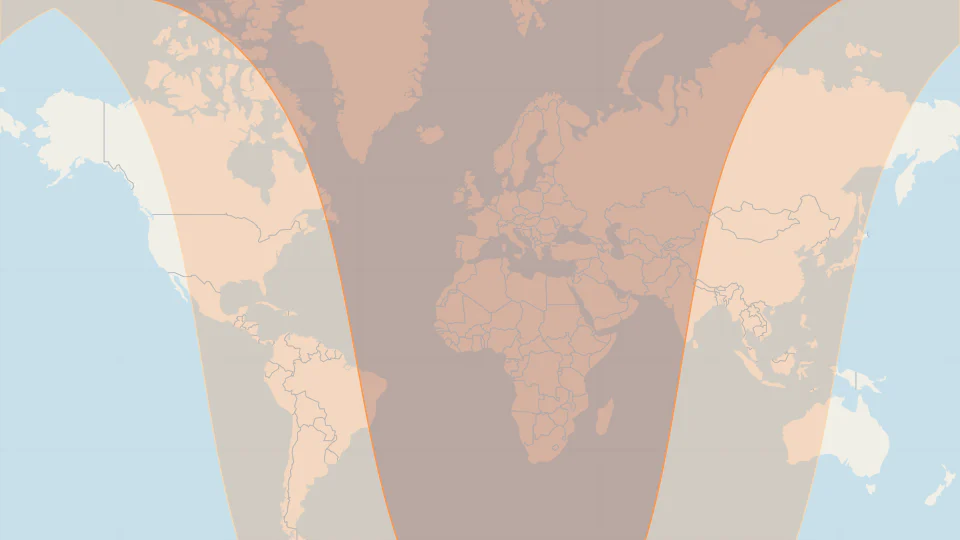 Lunar eclipseUpcoming event
Penumbral lunar eclipse
Visibility: The Americas, Europe, Africa and western AsiaOpen the eclipse map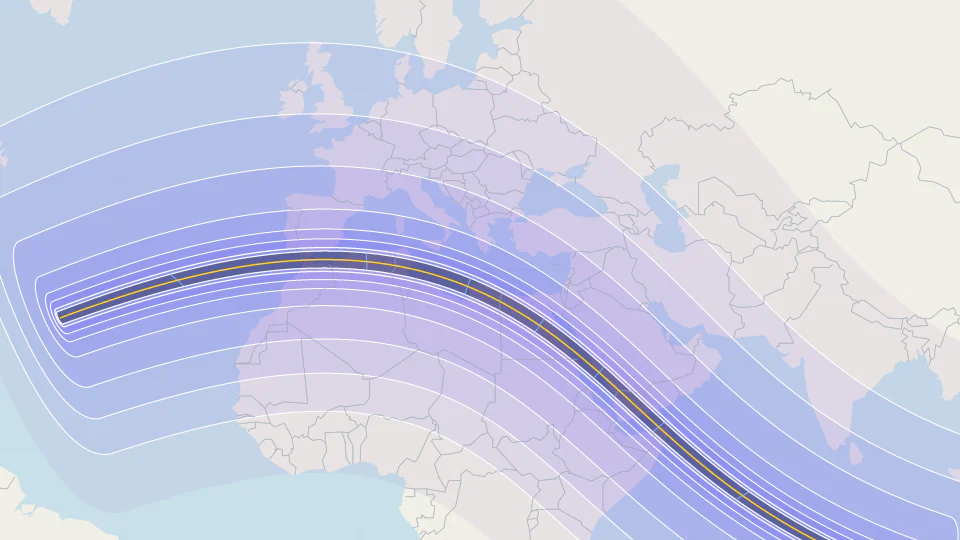 Solar eclipseUpcoming event
Total solar eclipse
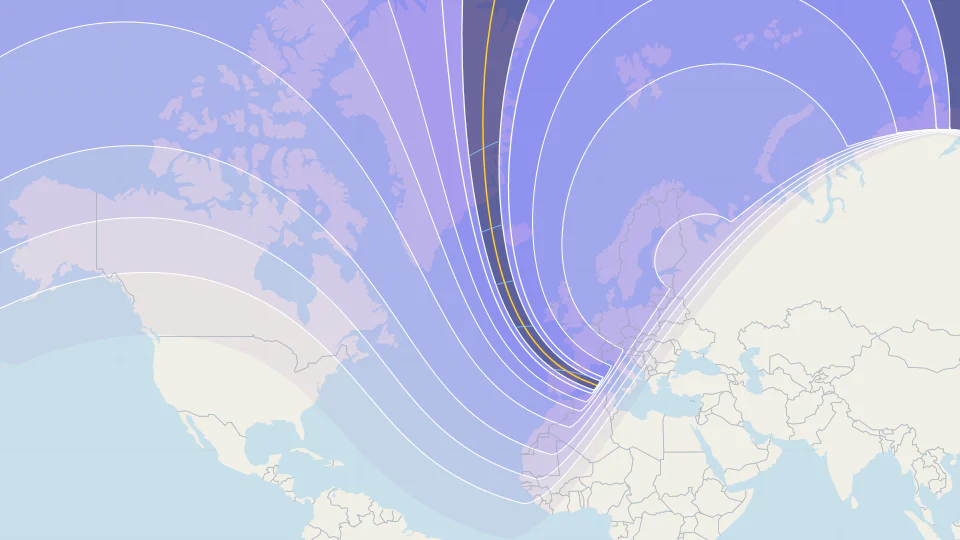
Visibility: Southern Europe, North Africa, the Middle East and the Indian OceanOpen the eclipse mapPast event
Past eclipses
Completed events with maps and local calculations preserved for reference.
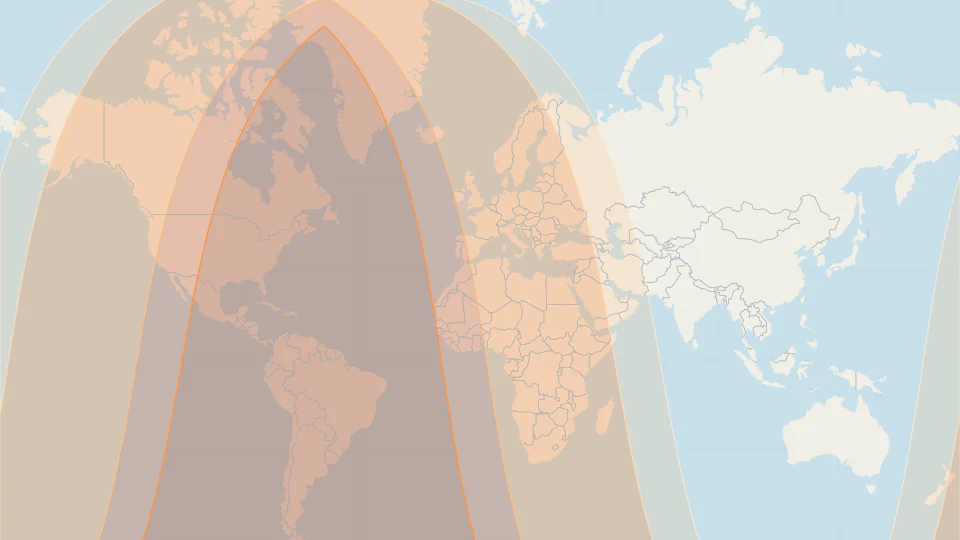
Not every eclipse looks the same. Here are all types of solar and lunar eclipses
Eclipses are phenomena that result directly from the geometry of the Sun-Earth-Moon system. Depending on the relative positions of these three bodies, we can observe a solar eclipse or a lunar eclipse. Each of these groups is divided into several types, differing in how they unfold and in the way the shadow falls on the observed body.
A solar eclipse occurs during a new moon, when the Moon is located between Earth and the Sun. A lunar eclipse is possible during a full moon, when Earth passes between the Sun and the Moon.
A solar eclipse depends on the observer's location
During a solar eclipse, the Moon casts a shadow on Earth. Because the Moon's diameter is about 400 times smaller than the Sun's diameter, while it is also about 400 times closer to Earth, the two objects have similar apparent angular sizes in our sky.
It is this coincidental ratio of sizes and distances that allows the Moon's disk to completely cover the Sun's photosphere. However, this does not happen during every eclipse. The Moon's orbit is elliptical, so its apparent size changes with its distance from Earth.
The Moon's shadow consists of the umbra, or total shadow, the penumbra, and the extension of the shadow cone known as the antumbra. Which of these zones an observer is in determines the type of eclipse that is visible.
Total solar eclipse
A total solar eclipse occurs when the observer is within the Moon's umbra. The apparent diameter of the lunar disk is then sufficient to completely cover the photosphere.
The total phase is visible only within a relatively narrow band crossing Earth's surface. Outside it, the same phenomenon is observed as a partial eclipse.
At totality, it becomes possible to observe the solar corona, the outer part of the Sun's atmosphere. Prominences and the chromosphere may also appear near the edge of the disk. Immediately before and after the total phase, photospheric light passing through irregularities along the Moon's edge creates the so-called Baily's beads.
Partial solar eclipse
We observe a partial eclipse when the Moon covers only part of the solar disk. From the observer's perspective, the center of the Moon's disk does not pass close enough to the center of the Sun's disk for total coverage to occur.
This situation also occurs in areas outside the path of totality during a total solar eclipse. The farther the observing site is from the axis of the Moon's shadow, the smaller the portion of the solar disk that is obscured.
Throughout the partial phase, part of the photosphere remains visible. Observation therefore requires filters intended for direct viewing of the Sun. Ordinary sunglasses do not provide adequate eye protection.
Annular solar eclipse
An annular eclipse occurs when the Moon passes in front of the central part of the Sun's disk, but its angular diameter is smaller than that of the Sun. This happens mainly when the Moon is sufficiently far from Earth, near the apogee of its orbit.
The observer is then in the antumbra. At the maximum of the phenomenon, a bright portion of the photosphere remains visible around the Moon's dark disk in the form of a ring.
Unlike in a total eclipse, the photosphere is not covered even at maximum. For this reason, appropriate eye protection is necessary at all times.
Hybrid solar eclipse
The rarest of the basic types of solar eclipses is the hybrid eclipse, also called an annular-total eclipse. At different points along the eclipse path, it may appear annular or total.
This is caused by the curvature of Earth's surface and the very slight difference between the apparent diameters of the Sun and Moon. In one part of the path, the tip of the umbral cone may not reach Earth's surface, resulting in an annular eclipse. Elsewhere, the planet's surface is already within the umbra, and a total eclipse is observed.
The type of eclipse changes along a single path moving across the planet's surface. This does not mean that an individual observer will see a full annular phase followed by a total phase.
Lunar eclipses occur in Earth's shadow
The mechanism of a lunar eclipse is the reverse. Earth is located between the Sun and the Moon, and the natural satellite passes through our planet's shadow.
Earth's shadow consists of the penumbra and the umbra. In the penumbra, Earth blocks only part of the Sun's disk as seen from the Moon's surface. In the umbra, the Sun is completely obscured.
Unlike solar eclipses, this phenomenon can be observed simultaneously from the entire nighttime hemisphere of Earth, provided that the Moon is above the local horizon.
Penumbral lunar eclipse
A penumbral lunar eclipse occurs when the Moon's disk passes only through Earth's penumbra and does not enter the umbra. The change in the brightness of its surface is relatively slight in this case.
During shallow penumbral eclipses, the decrease in brightness may be difficult to notice without photography or photometric measurements. With deep entry into the penumbra, one part of the disk becomes distinctly darker.
There are also total penumbral eclipses, during which the entire Moon's disk is within Earth's penumbra, but no part of it crosses the boundary of the umbra. They are still classified as penumbral eclipses.
Partial lunar eclipse
During a partial lunar eclipse, part of the disk enters Earth's umbra while the remaining part stays outside it. A distinct, curved boundary of our planet's shadow is then visible on the satellite's surface.
The phenomenon begins with the penumbral phase. Once the first portion of the disk crosses the umbral boundary, the partial phase begins. The maximum portion of the Moon's diameter immersed in shadow depends on the precise geometry of the particular eclipse.
No protective filters are needed for observation. Unlike the Sun, light reflected from the Moon's surface does not pose a risk to eyesight.
Total lunar eclipse
A total lunar eclipse occurs when the Moon's entire disk is within Earth's umbra. However, the satellite does not become completely invisible.
Some solar radiation passes through Earth's atmosphere and is refracted. Shorter wavelengths are scattered more strongly, while red and orange light reaches the interior of Earth's shadow more effectively. As a result, during the total phase the Moon may take on a color ranging from dark gray and brown to red or orange.
The brightness and color of an eclipsed Moon are not identical during every event. They depend, among other things, on the satellite's path through the shadow and the current optical properties of Earth's atmosphere, including the amount of aerosols in the stratosphere.
Why eclipses do not occur at every new moon and full moon
The Moon's orbit is inclined by about 5.1° relative to the plane of the ecliptic. For this reason, during most new moons the Moon passes above or below the Sun in the sky, and during most full moons it misses Earth's shadow.
An eclipse can occur when a new moon or full moon falls near one of the Moon's orbital nodes, the points at which its orbit crosses the plane of the ecliptic. Periods during which the geometry allows eclipses to occur are known as eclipse seasons.
As a result, solar eclipses are primarily divided into partial, total, annular, and hybrid eclipses, while the basic classification for lunar eclipses includes penumbral, partial, and total eclipses. Which variant occurs is determined by the Moon's position relative to its orbital nodes, its distance from Earth, and the precise geometry of the shadow at the time of the event.