Space weather
Sunspots
Check where sunspots and active regions are located today. We update the current image of the Sun’s disk every 30 minutes.

CURRENT IMAGE OF THE SUN
Sunspots on the solar disk
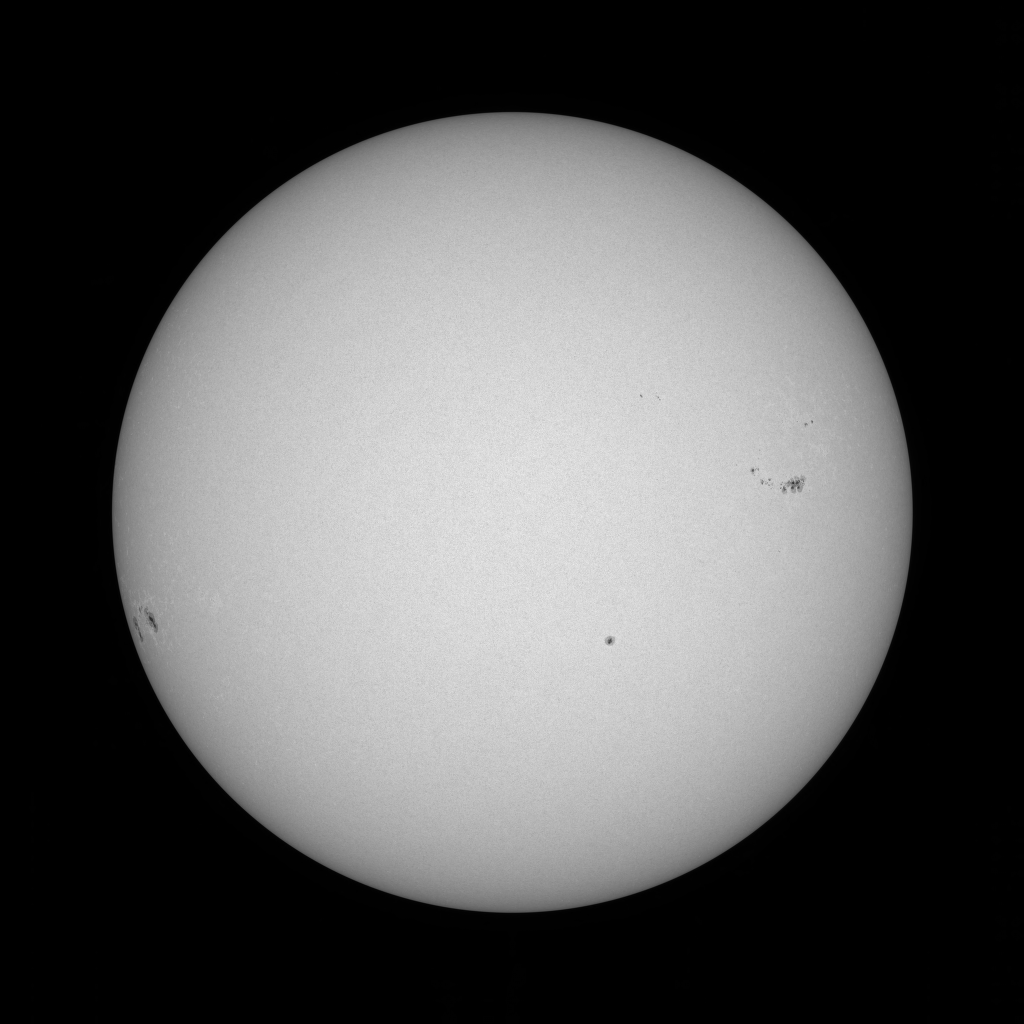
Region labels: SkyLep based on NOAA data.Courtesy of NASA/SDO and the AIA, EVE, and HMI science teams.
NOAA SWPC
Active solar regions
Each row represents one active region. A single region may contain several separate sunspots.
| Active region | Sunspot count | Magnetic class | Position on the disk |
|---|---|---|---|
| N18W46 | 8 | Beta | N18W46 |
| S13W14 | 1 | Alpha | S13W14 |
| N10W41 | 30 | Beta-Gamma-Delta | N10W41 |
| S13E71 | 2 | Beta | S13E71 |
| N22W21 | 2 | Beta | N22W21 |
Magnetic class describes the magnetic field configuration in an active region. Alpha denotes a simple sunspot group with one polarity, while Beta denotes a region with two opposite polarities. More complex configurations receive additional designations, such as Gamma or Delta. A complex magnetic field may be associated with greater activity, but the class alone does not predict a specific flare.
View recent solar flares →What are sunspots?
Sunspots are darker areas visible on the surface of the Sun. In reality, they are still extremely hot, but their temperature is lower than that of the surrounding photosphere, which is why they appear dark against it.
They form in places where a strong magnetic field hinders the transport of energy from the Sun's deeper layers. Sunspots often form groups and are part of larger areas called active regions. It is in such regions that solar flares and coronal mass ejections, or CMEs, can occur. However, the presence of sunspots alone does not mean that such an event will definitely happen.
The number, size, and complexity of sunspots change along with solar activity. During periods of greater activity, many groups may be visible on the solar disk at the same time, whereas during quieter periods the Sun may remain almost completely free of sunspots for some time. Observing them is therefore one of the simplest ways to track changes in our star's activity.
What do the numbers mean?
The numbers visible next to sunspots, for example AR 4xxx, refer to entire active regions rather than individual sunspots. A single such region may contain several, a dozen, or many more sunspots of varying sizes.
The data presented in the table come from NOAA reports. The stated number of sunspots is the value reported by the source and is not calculated automatically based on the image of the Sun visible on the page.
The positions of the labels in the image should be treated as approximate. The image of the Sun and the report describing the active regions may come from slightly different times, so the label is not always located exactly above the center of the visible sunspot group.